Did your rankings start moving on Tuesday 10 November? That’s the November 2026 core update. Google Search Central announced it that day and pointed to the Search Status Dashboard. The rollout may take up to two weeks. Rankings will keep shifting until it ends. So right now the most useful things you can do are save a clean baseline, watch calmly and hold off on changes.
This guide covers what Google has confirmed, how this update fits with March and May, why the timing around the holidays matters, and exactly how I’d track it.
What Google Has Confirmed About the November 2026 Core Update
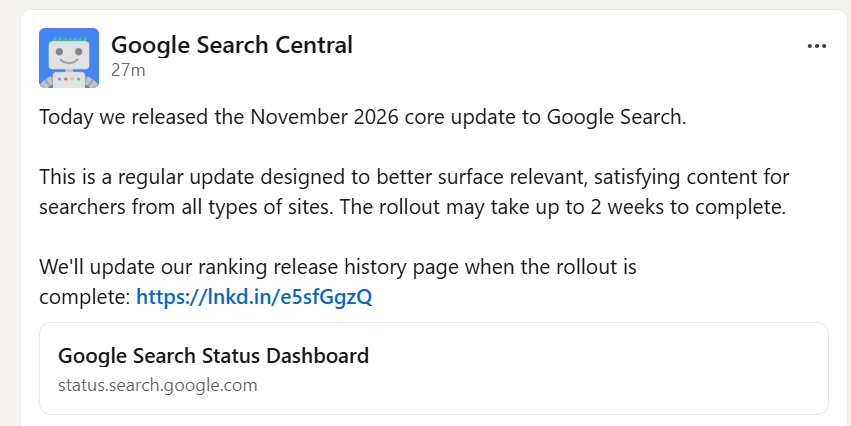
Here is the announcement Google Search Central posted:
The facts so far are short, which is normal for a core update:
- Start: Google released the update on 10 November 2026. Its announcement links to the Google Search Status Dashboard, where ranking updates and their end dates are tracked.
- Expected length: “The rollout may take up to 2 weeks to complete.” If it runs the full two weeks, it ends around 24 November.
- What it’s for: Google called it “a regular update designed to better surface relevant, satisfying content for searchers from all types of sites.” That’s the same wording it used for May and December 2025.
- When it’s done: Google says it will update its ranking release history page once the rollout is complete.
- Guidance: there’s no blog post and no new advice. Google’s standing documentation on core updates still applies.
Like every core update, this is not a penalty. Google is reassessing how its systems judge content across the web. Nothing will appear in your Manual actions report, and there’s no reconsideration request to file. If you want the full background on reading the dashboard, see our guide to the Google Search Status Dashboard.
How It Fits With the Other 2026 Updates
This is the third broad core update of 2026. Here is the year so far:
- March 2026 core update: 27 March to 8 April, about 12 days. Our March 2026 core update recap covers what changed.
- May 2026 core update: 21 May to 2 June, about 12 days. See our May 2026 core update recap.
- September 2026 spam update: 24 September to 8 October. That was a spam update, not a core update. Our September 2026 spam update recap explains the difference.
- November 2026 core update: started 10 November, still rolling out.
The gap matters. May finished on 2 June, so this update comes after a gap of more than five months. That is much longer than the six weeks between March and May. For sites that lost traffic in March or May and have been improving since, this is the first real chance to see that work rewarded. Our guide on how long core update recovery takes explains why Google often needs a core update before improvements show.
For a wider view of the year, our overview of Google core updates in 2026 brings March and May together.
Why the Timing Makes This Update Harder to Read
Two things sit close to this rollout. Both can twist what you see in your data.
Rankings Were Already Moving Before It Started
SEO tracking tools and forums reported unconfirmed ranking movement on 20 and 21 October, again on 24 October, and on 8 and 9 November, the weekend just before the announcement. Google didn’t confirm any of these. But if your baseline week includes them, your comparison will be off.
That’s why I’d use 27 October to 2 November as the main baseline, not the week right before the update. I’d also save 3 to 9 November as a second baseline, so you can see if anything started early.
It Will Finish During the Holiday Rush
If the rollout takes the full two weeks, it ends around 24 November. US Thanksgiving is 26 November and Black Friday is 27 November. Core updates can also run longer than Google’s estimate. The December 2025 core update took about 18 days, from 11 to 29 December.
For shops and deal sites, search demand jumps in late November whatever happens to rankings. So clicks and impressions can rise even if your positions fall, or fall after a promotion ends even if your positions hold. Always check average position first. Then compare clicks against the same days last year, not only against last week.
What Not to Do While It Rolls Out
The worst time to make big changes is in the middle of a rollout. Rankings swing up and down for days, and you can’t tell whether your change or the update caused what you see next.
- Don’t rewrite or delete pages because of a drop in the first few days. Many early drops partly come back before the rollout ends.
- Don’t change URLs or add redirects unless you already had them planned for other reasons.
- Don’t disavow links in a panic. Core updates are about how Google judges content and usefulness, not a link penalty.
- Don’t make “quick fix” edits such as stripping out page sections or adding keywords. Google’s own core updates documentation warns against this.
You can keep publishing normal content and fixing real errors, like broken pages or server problems. Just write down what you changed and when.
How I’d Track the November 2026 Core Update
This is the routine I follow for every core update. It keeps you calm and gives you clean data at the end.
Save Your Baselines Today
In the Search Console Performance report, export clicks, impressions, CTR and average position for 27 October to 2 November, by page and by query. Then export 3 to 9 November too. If you sell anything seasonal, also export 10 to 30 November 2025 so you have last year’s holiday pattern.
Keep a Simple Change Log
Note 10 November as the start date. Add every change you make to the site, every campaign or sale you run, and the date Google confirms the update is complete. A plain spreadsheet is enough.
Check Two or Three Times a Week, Not Every Hour
Look at average position, impressions, CTR and clicks by search type: Web, Image, Video and News. Compare position with CTR. If position held but CTR fell, the cause is more likely a change on the results page, such as an AI Overview, than a ranking drop.
Wait for the Finish, Then Wait a Week
Google’s documentation says to wait at least a full week after the rollout is complete before you judge the impact. Then compare that week with your baseline week. Look at your top pages and queries, and decide whether each drop is small, like position 2 to 4, or large, like position 4 to 29.
Only Then Decide What to Improve
For small drops, Google says you don’t need to do anything drastic. For large drops that last, review the affected pages honestly. Ask whether they are the best answer for the searcher, whether they show real experience, and whether other pages on the web now serve people better. Google’s documentation says deleting content should be a last resort.
What Core Updates Tend to Reward
Google won’t say what changed in this update, and nobody outside Google knows the details. But its documentation is clear about what its systems try to reward, and that hasn’t changed. When I review a page after a core update, I ask the same questions Google suggests in its helpful content guidance:
- Does it give original information? Your own data, testing, photos or experience, not a rewrite of what already ranks.
- Is it the most complete answer? Would someone leave the page feeling they don’t need to search again?
- Is the expertise clear? Can a reader see who wrote it and why they know the topic?
- Was it written for people? Or mainly to rank, with padding, repeated keywords and vague headings?
- Is it easy to use? Fast, readable on a phone, and not buried under ads or pop-ups.
These questions matter most for the pages that dropped the most. A site-wide review only makes sense when the drop is large and spread across many pages.
Check Discover and Image Search Too
Core updates don’t only affect web results. Google Discover and image search can move as well. In Search Console, check the Discover report separately from the Performance report for Search, and filter Search by type so image traffic isn’t hidden inside web results.
If you get a lot of Discover traffic, expect it to swing more than search traffic. Discover already changes a lot from week to week, so give it a longer window before you judge it.
If You Were Hit in March or May
Google’s guidance says improvements can take months to show, and some sites may not see them until the next core update. For anyone hit earlier this year, this is that next update.
So watch your March and May losing pages closely. If they climb during this rollout, your changes were likely the right ones. If they don’t move, don’t give up on good changes straight away. Google also makes smaller core updates it doesn’t announce, so gains can still come later.
What I wouldn’t do is undo good work just because one update didn’t reward it. Fix what is clearly weak, keep what is clearly helpful, and keep notes so you can learn from the next update too.
What I’ll Update Here
I’ll keep an eye on the Search Status Dashboard and add the completion date and length here as soon as Google confirms them. When it’s done, I’ll publish a full recap with what changed and the exact Search Console dates to compare.